As of November 2026: 66 threads archived in full · 178,000 posts by 2,200 members, 2005–2026 · 64,000 images · 10 Notebook pages built from 13,000 sourced points · 1,950 more threads catalogued
The best information on Sinodefenceforum is buried in thousand-page threads. SDF Observatory downloads the threads I follow, checks them for new posts, keeps track of who quoted whom, and makes every post searchable in English and Chinese. The largest, Chinese Engine Development, has more than 10,000 posts on its own. A vision model has described nearly every image, so pictures can be searched by what’s in them and by any text they contain.
The Notebook
The home page is now a Notebook, with one page per subject, like the J-36 or the Type 055, written from every post that names it. A model reads those posts and turns them into points: one claim, estimate, or event each, saying who said it, when, and how firmly, with an exact quote checked against the post. The J-36 page alone has 2,300 of them.
Each page is laid out from its points: a short brief, a dated history, sections with tables and charts where members’ estimates differ, the arguments that are still open, and what changed since my last visit. Pages update on their own as new posts arrive, and every statement opens the posts behind it.
Research
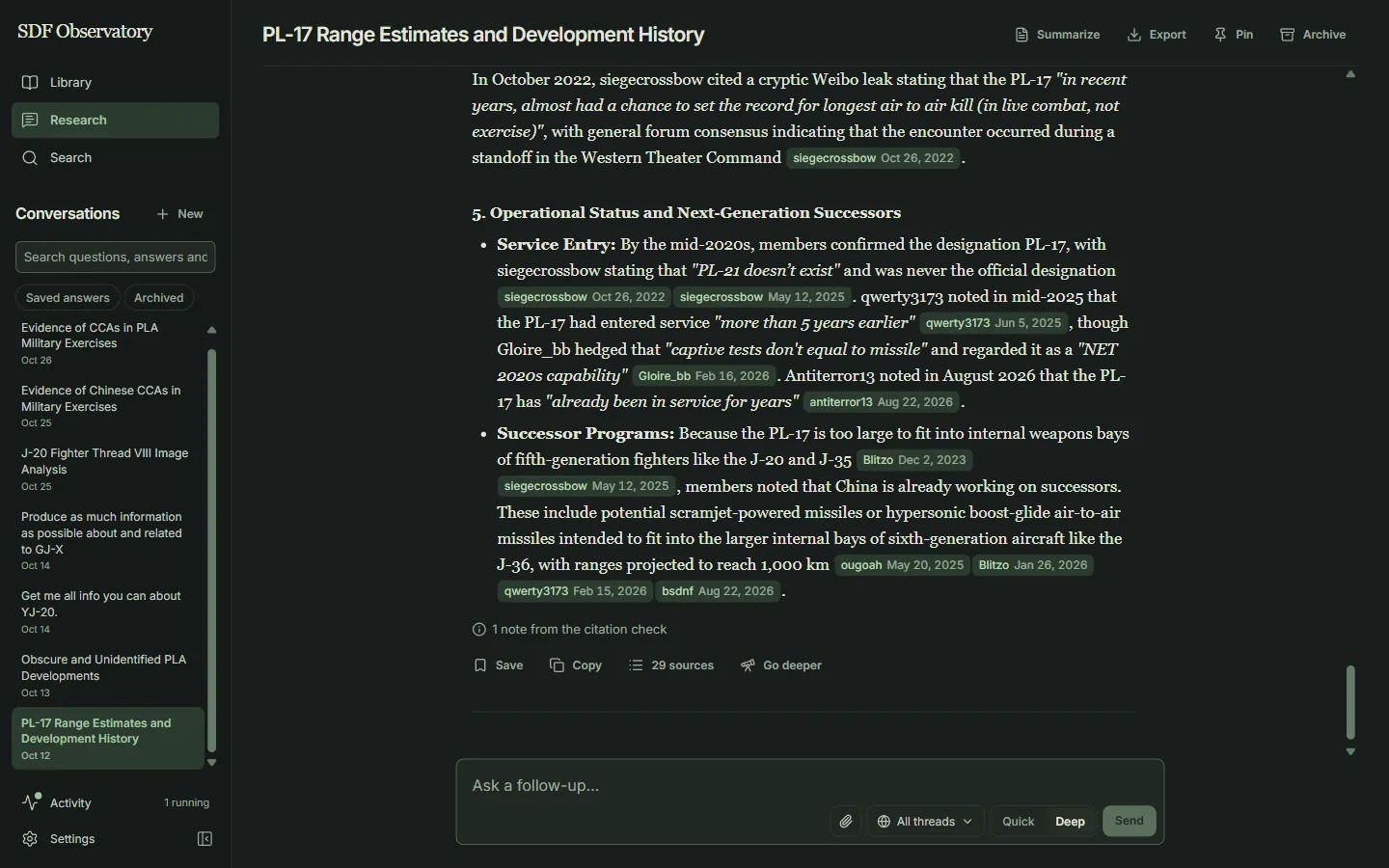
The Research page works like a conversation. The model writes its own search queries, and every answer has to cite specific posts. Before an answer is shown, a check confirms that each cited post exists, is in scope, contains the quoted text, and was written by the member it’s attributed to. Questions can include images, PDFs, or text files. The same research tools are also available to Claude Code and Claude Desktop through a local, read-only MCP server.
What didn’t work
The first version pulled structured “claims” out of every post before it could answer anything. I ran a pilot on 300 posts, and answers were just as good without the claims. So I removed that step, and posts are now searchable as soon as they’re downloaded. Points came back later in the Notebook, but they’re built per subject in the background, and nothing waits for them.